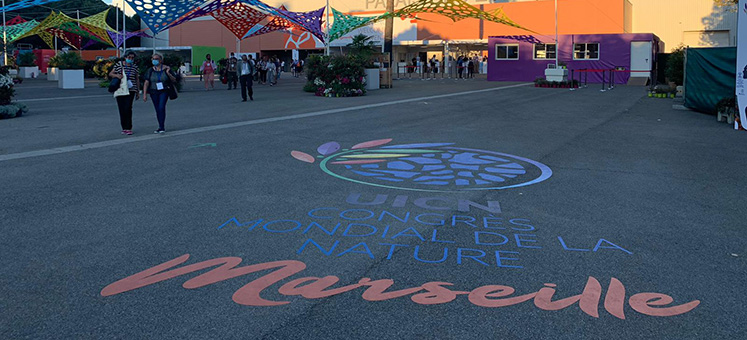


A delegation from the Biodiversity Foundation is currently participating in the World Congress of the International Union for Conservation of Nature (IUCN), which is being held from September 3 to September 11 in Marseille, France.
A delegation from the Biodiversity Foundation is currently participating in the World Congress of the International Union for Conservation of Nature (IUCN), which is being held from September 3 to September 11 in Marseille, France.
Under the theme “Nature, Our Future” the congress brings together world leaders and representatives from governments, the world of science and academia, indigenous peoples’ groups, non-governmental organizations and businessmen, in order to address urgent environmental challenges.
From the Biodiversity Foundation we have attended this Forum with the aim of highlighting our different actions and projects, participating in different sessions to promote alliances and actions contemplated, for example, within the framework of the LIFE INTEMARES project, as well as other actions related to marine protected areas in North Africa, France or Portugal. In addition, during the congress, we have been able to hold various meetings and meetings with representatives of public institutions, the private sector and entities from various fields.
The importance of networking in marine governance
The director of the Biodiversity Foundation, Elena Pita, has participated in several sessions within the framework of the congress. Last Saturday, September 4, he participated in the official presentation of the “Global Alliance for Marine Protection between Marine Protected Area (MPA) networks of managers and trust funds“.
The Global Alliance for Marine Protection is a platform made up of MedPAN, RedLAC, Costa Rica por Siempre, MedFund, an international cooperation project between networks of global marine protected area managers, Ocean Governance, and its partners, who have joined forces worldwide to create this new alliance and act as a global community of actors to promote the effective management and sustainable financing of marine protected areas. marine resources, marine protected areas, and thus support the implementation of the post-2020 MPA objectives.
During this meeting we have highlighted the pillars of integration on which the LIFE INTEMARES project is based, by promoting a model of governance and management of the sea with an objective also at an international level since “with regard to the conservation of biodiversity, we have to think globally and promote alliances to achieve our common challenges”, as highlighted by Elena Pita.
In relation to our involvement in initiatives that promote MPA networks, our director recalled that “the Biodiversity Foundation was invited to join the transatlantic network, as coordinator of LIFE INTEMARES, at the start of the project in 2017”. Regarding this milestone, it should be noted that “our objective was to participate in networking in our area of influence, which includes the Atlantic Ocean (North, South and the Macaronesia area) and the Mediterranean Sea”.
Trends and challenges in conservation financing in the Mediterranean
During the development of the Forum, Elena Pita also participated in the panel “Financing nature conservation in the Mediterranean”. The event, coordinated by the Mava Foundation, presented an overview of government funding, which is critical for the conservation of the region, and highlighted the existence of threats from unsustainable development policies and governance deficiencies as well as the potential for adequate economic financing after the crisis.
In her speech, Elena Pita explained several keys, including the importance of supporting the recovery after the health crisis in the short term, promoting a process of structural transformation in the medium term, and achieving, in the long term, a more sustainable and resilient development from an economic-financial, social, territorial and environmental point of view that allows the promotion of a green transition that takes into account the environmental limits of the planet and thus stops the processes of ecological deterioration.
In addition, he highlighted the Recovery, Transformation and Resilience Plan (PRTR) as a tool to carry out this transition process. The PRTR plan is “aimed at the protection and conservation of the wealth of natural assets as a sustainability asset for the territories and a fundamental element to face climate challenges, promote science, R+D+I and address the demographic challenge to guarantee territorial cohesion and inclusive growth throughout the territory within environmental limits”.
Elena Pita also stressed the importance of guaranteeing the efficiency of the management of these funds , highlighting the search for transformative projects of a strategic nature with a vocation to drive the economy and that can be scaled up or replicated at different levels.
With this objective, the Biodiversity Foundation will mobilise funds through calls for aid within the framework of the PRTR plan around the following priority needs; the incorporation of nature into cities; economic recovery through the ecological transition; the promotion of research applied to biodiversity management; and the need to conserve threatened biodiversity.
Our participation in the Members’ Assembly
As members of the Spanish delegation of the Ministry for the Ecological Transition and the Demographic Challenge, from the Biodiversity Foundation we participate in the IUCN Assembly of Members, which implies voting on behalf of Spain the different motions that will outline the work of the coming years.
From today until September 10, the vote on these motions will take place, of which the Ministry co-sponsors two. The first of these, “Climate change and biodiversity crisis”, seeks to promote measures that recognize that the climate crisis and biodiversity loss are interrelated and therefore that synergies must be strengthened, research must be increased and nature-based solutions and international commitments must be implemented.
The second motion, “One Health”, seeks to ensure human, animal and environmental health, as well as avoid pandemics. It links human, animal and botanical health with the conservation of ecosystems, fundamental elements to ensure better human health, prevent future pandemics and fight the biodiversity crisis in the context of climate change.