

Today is our day, the International Day for Biological Diversity, the day of biodiversity, which is celebrated on May 22, in commemoration of the approval of the Convention on Biological Diversity, in 1992. With this celebration, the United Nations seeks to disseminate the meaning and importance of biological diversity (species and ecosystems) in our lives and, at the same time, highlight the responsibility that all people have to safeguard ecosystems and treat them sustainably to ensure our survival.
Spain is the country with the greatest biodiversity in the European Union and belongs to an area designated as one of the 25 biodiversity hotspots on the planet. Spain’s high biological diversity is the result of the interaction of multiple factors, highlighting its geographical location and the great climatic and orographic variability.
We host the 56 % of the birds included in the Birds Directive and 32 % of the species included in the Habitats Directive. In addition, 56% of the habitat types identified in this Directive are present in Spain .
Spain is the country in the European Union that contributes the largest area to the Natura 2000 Network. It has 27% of its terrestrial territory (140,448 km2) and more than 12% of the marine protected under this figure, with nearly 2,000 spaces.
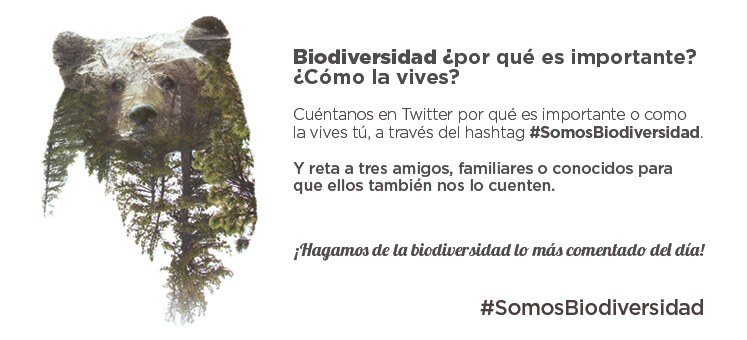
Despite all these important data, according to the recent Eurobarometer, 32% of Spaniards say they have heard the concept of biodiversity, but without knowing what it means, and 27% have never heard of it, and only 41% know its meaning. Therefore, in our day, to help make it known, we want social networks to talk about #Biodiversidad because #Somosbiodiversidad.
This year, the day focuses on biodiversity as the foundation of our food and health, its objective is to promote knowledge and raise awareness of the close dependence that food production systems, nutrition, and health have on biodiversity and healthy ecosystems. It also celebrates the diversity that our natural systems offer for human existence and well-being on Earth, while contributing to the achievement of other Sustainable Development Goals (SDGs), such as climate change mitigation and adaptation, ecosystem restoration, clean water, and zero hunger, among others.
We must take care of biodiversity, only in this way will we be able to improve the results reflected in the latest report “Global Assessment on Biodiversity”, by the Intergovernmental Science-Policy Platform on Biodiversity and Ecosystem Services (IPBES). According to this report, around one million species are in danger of extinction. In addition, in the last 50 years, biodiversity and ecosystem services are deteriorating worldwide and at a faster rate than ever before: 75% of the earth’s surface has undergone considerable alterations; More than 85% of wetland area has been lost and 66% of ocean surface is experiencing cumulative effects.