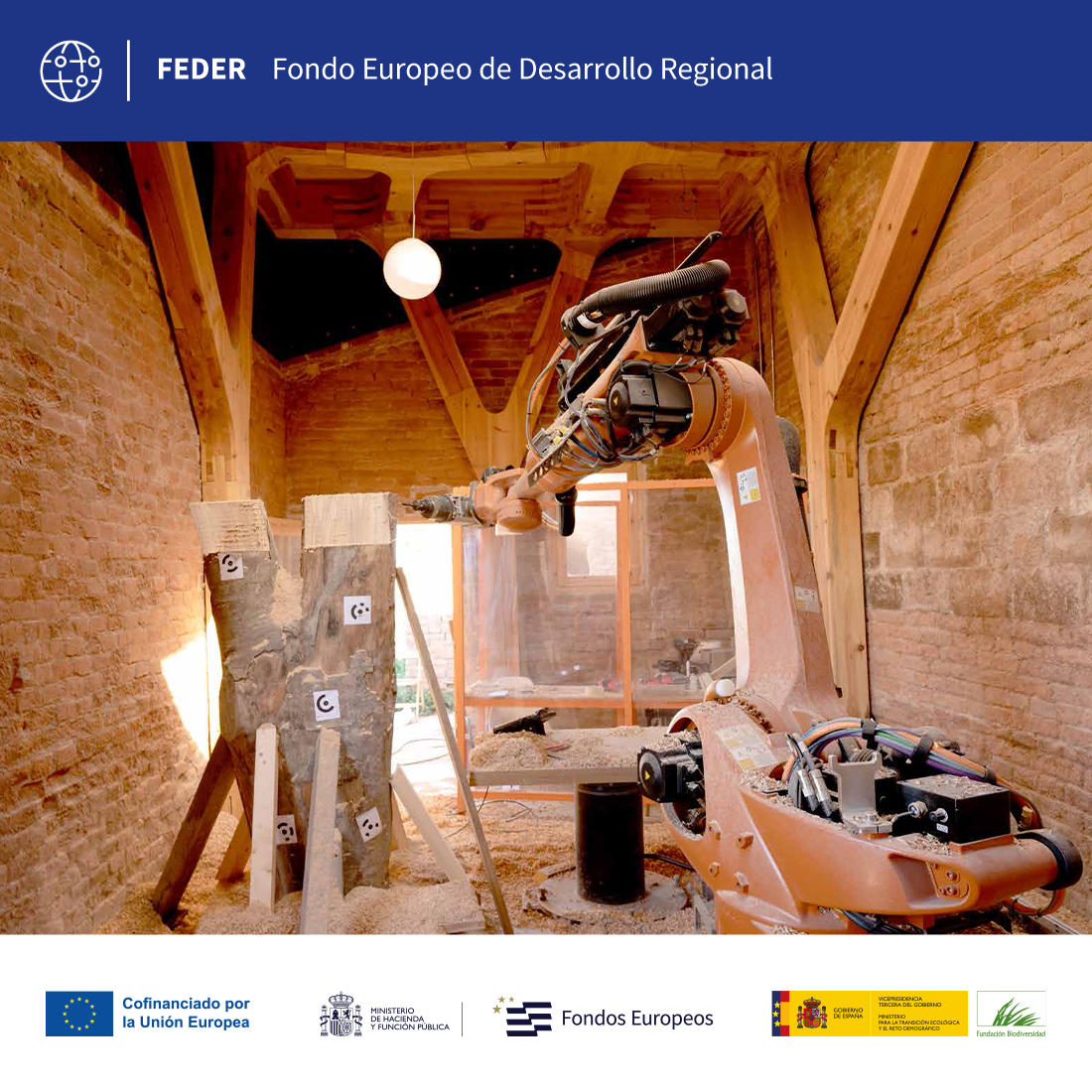
FORESTED 2.0. Promoting Forestry. Promotion of the transformative potential of forest management for the sustainable production of high value-added wood and the promotion of the bioeconomy in the building sector.
FEDER
The project seeks to mobilize underutilized forest species to incorporate them into the building bioeconomy through sustainable management. To this end, it carries out the forest and socio-economic characterisation of forest stands with potential, selecting 12 pilot areas and mobilising some 120 tonnes of wood, together with the manufacture and testing of more than 50 construction elements and 12 hybrid prototypes. In addition, it promotes PEFC + Carbon certification in 600 ha and the creation of a BioHub as an innovation node, including a participatory governance, training, communication and awareness strategy. All this is intended to achieve results related to innovation, transfer and dissemination of knowledge, through the creation of more than 37 transferable technical documents, the publication of more than 5 articles in specialized media and more than 10 functional prototypes manufactured for building.
Line of action:
Terrestrial ecosystemsStatus:
En ejecuciónLocation:
Castilla-La Mancha (Albacete, Cuenca and Guadalajara), Andalusia (Granada, Cordoba, Malaga and Jaén), Catalonia (Barcelona) and the Community of Madrid.Execution date:
2026End date:
2028Duration:
18/02/2026 - 31/01/2028Total budget:
1.650.000 €Amount of aid from the Biodiversity Foundation:
€922,737.21Association for Spanish Forest Certification (PEFC SPAIN)
University of Castilla-La Mancha
National Association of Forestry Companies (ASEMFO)
Consolidate an integrated forestry model for the forest bioeconomy, which strengthens territorial resilience through the sustainable management of forest masses, the mobilization of underutilized species and their transformation into innovative construction solutions. The project articulates the entire forest-industry-construction chain with climate traceability, validated prototypes and knowledge transfer to generate green employment and high added value in rural areas. It contributes to improving green infrastructure, biodiversity and ecological connectivity, aligned with the New European Bauhaus (NEB) and European decarbonisation and reindustrialisation policies, strengthening local capacities, participatory governance and the demographic attractiveness of the target regions.
- Identify, prioritize and characterize forest masses of underutilized local species with construction potential, integrating criteria of biodiversity, green infrastructure and climate traceability.
- To mobilise and transform these woods through sustainable, innovative and certified use, developing structural and non-structural prototypes that demonstrate their technical, economic and environmental viability.
- Transfer knowledge and skills to the territory through training, dissemination and participatory governance, strengthening local value chains, creating green employment and contributing to reindustrialisation, climate resilience and the fight against depopulation in the target regions.
- Comprehensive characterization of forest masses and socioeconomic context. Identification, mapping and prioritization of stands with underutilized species, integrating silvicultural analysis, biodiversity, ecosystem services, construction potential and demographic-business context. It includes forest inventories, interviews and georeferenced cartography.
- Sustainable use and certification in the field. Practical execution of the use of the selected species, with formalization of contracts with owners, cutting, cubing, transport and climate traceability, validating the technical and economic applicability in real conditions.
- Development of innovative construction prototypes. Transformation of the extracted wood into ≥52 prototypes (single- and multi-species CLT and hybrid solutions), evaluating its technical, environmental and regulatory feasibility. Technical documentation and transfer to the sector through files and physical/digital exhibition.
- Climate traceability, certification and impact assessment. Implementation of the PEFC + Carbon certification and ecosystem services on 600 ha, calculation of the carbon embedded in the prototypes and development of the ObservaPEFC platform for monitoring and transfer.
- Socioeconomic, territorial and governance analysis. Socioeconomic and territorial diagnosis of the forest-industry-construction chain, estimation of potential green employment and participatory definition of governance scenarios and business models for the forest bioeconomy.
- Design of the BIOHub and roadmap for its implementation. Technical and strategic proposal to create a territorial BIOHub, integrating a Living Lab and a regulatory Sandbox for experimentation, transfer, governance and visibility of the model in other territories.
- Training, dissemination and gender. Plan to promote the bioeconomy through conferences, workshops, talks in schools and institutes, conferences with prescribers and women, promoting green vocations, gender equality, technical training and knowledge transfer.
- Multichannel dissemination. Itinerant technical exhibition in Andalusia and Castilla-La Mancha, publication of the book FORESTED 1+2 and digital platform with all the technical and informative materials to guarantee replicability and transfer.
- Coordination and evaluation. Management, monitoring and evaluation of the project, with a focus on technical, administrative and gender quality, and ensuring compliance with the indicators and the satisfaction of the partners.
The FORESTED 2.0 project will have a high environmental, socio-economic and territorial impact, boosting the bioeconomy, green reindustrialisation, green infrastructure and rural climate resilience:
- Improving biodiversity through the sustainable management of ≥12 stands with underutilized local species.
- Generation of technical and scientific knowledge: inventories, GIS, cubications, governance and market models, on an open digital basis.
- Manufacture of ≥52 prototypes that validate innovative and sustainable construction solutions.
- Climate traceability system with PEFC+Carbon certification and embedded carbon calculation. PEFC ObservaPlatform.
- Creation of ≥150 green jobs in the forest-industry-construction chain, with a focus on women and young people.
- ≥20 training activities with a gender perspective.
- Dissemination: exhibition, FORESTED 1+2 book and web platform. The project transforms rural territories into resilient and dynamic spaces.
It is expected to select 12 pilot areas (6–8 municipalities per region), the mobilization of about 120 tons of wood (≈20 t per prioritized species), the certification of 600 ha PEFC + Carbon, and the manufacture of more than 50 construction elements, including 40 samples of CLT (experimental pieces of cross-laminated wood), with the possible first in Spain with Rodeno pine. and 12 hybrid and experimental prototypes (I-joist, DLT, agroforestry panels, mixed wood-to-metal or wood-earth solutions). Each prototype will have technical data sheets and embedded carbon calculations, comparison with conventional materials and a catalog of industrial scenarios. In addition, an open digital database will be developed, ≥5 specialized articles, a FORESTED 1+2 book, a traveling technical exhibition, school workshops, sectoral talks and gender round tables.

FORESTED 2.0. Promoting Forestry. Promotion of the transformative potential of forest management for the sustainable production of high value-added wood and the promotion of the bioeconomy in the building sector.

 back to search