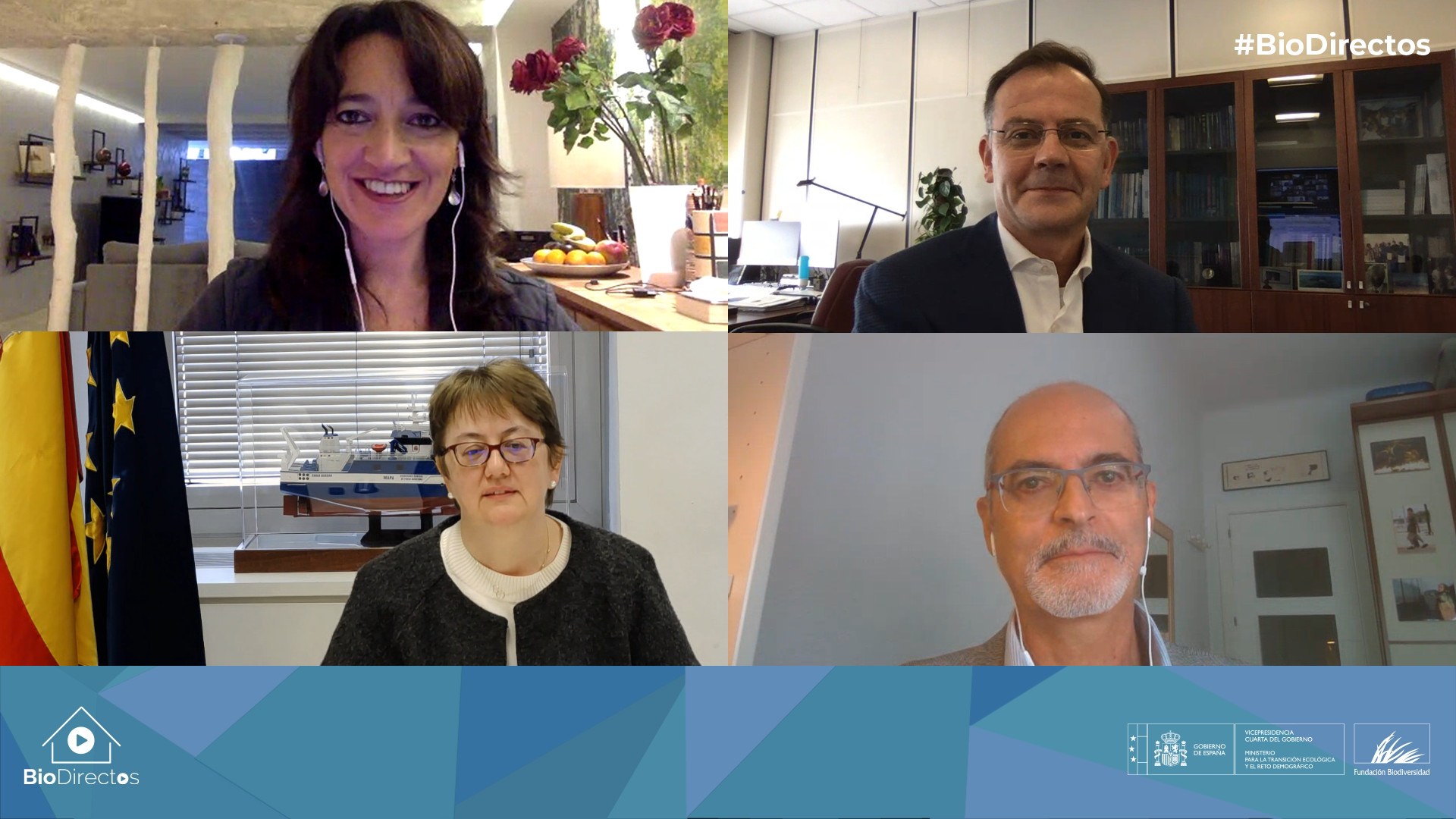


Coinciding with the celebration of Aquaculture Day, the seventh edition of the #Biodirectos series has been broadcast.
Coinciding with the celebration of Aquaculture Day, the Biodiversity Foundation of the Ministry for Ecological Transition and the Demographic Challenge (MITECO) has today broadcast the seventh edition of the #Biodirectos series, a series of online meetings, broadcast live and simultaneously on the different social media channels (Twitter, Facebook and YouTube).
Today’s program “Cultivating and caring for the sea” has addressed the importance and projection of aquaculture activity in our country and in the world, from the perspective of its sustainability and contribution to the protection of the environment and its commitment to social and economic development in the places where it is developed.
The meeting was attended by Alicia Villauriz, Secretary General of Fisheries of the Ministry of Agriculture, Fisheries and Food, who stressed that aquaculture in Spain is a strategic activity for food supply and committed to sustainability.
Villauriz was accompanied at this meeting by Manuel Barange, director of the Fisheries Division of the Food and Agriculture Organization of the United Nations (FAO), and Javier Ojeda, Secretary General of the European Aquaculture Federation (FEAP) and the Spanish Association APROMAR. All participants pointed out the important role that aquaculture plays in providing consumers with the highest quality animal protein with the lowest environmental impact.
In this seventh #Biodirectos, the relevant role of aquaculture in our country has been highlighted, given our biogeographical conditions, and the importance of reinforcing the commitment of this activity to sustainable development.
According to the FAO, within the framework of the blue economy, aquaculture is the food production sector that has grown the most in recent decades, contributing, in 2018, 62.5% of the world’s production of edible fish.
The leading role in this growth is Asian countries, with China leading the way. But in recent years, Europe in general and Spain in particular, have promoted a modern aquaculture sector committed to the environmental, social and economic aspects of the coastal and rural areas in which it is developed.
Currently, more than 50 species of fish, molluscs, crustaceans and algae are farmed in Spain. The most characteristic crop of our country is the rafts. There are 3,663 specifically, in which mussels are mainly grown. Our country leads the production of mussel farming with the harvest of more than 240,000 tonnes.
We also have 1,085 intertidal farms, where clams and cockles are mainly planted. Land-based tanks, in which flatfish such as turbot, sole or trout are grown, are another clear example of farming. Finally, the Andalusian estuaries produce fish and crustaceans with innovative systems such as floating nurseries in which sea bream, sea bass and sea bass are raised in the sea.
In addition, Spain is a leader in research, technological development and innovation, with more than 40 research centres and nearly 90 university departments working in aquaculture. These centers lead projects and research at an international level, such as octopus or bluefin tuna farming.
Spanish aquaculture contributes to the conservation of biodiversity and promotes sustainable development: it promotes the social and economic development of many rural and coastal areas of our geography; it acts as an indicator of environmental quality in rivers and coasts; and, in many cases, it acts as an effective tool for the protection of vulnerable or at-risk species.