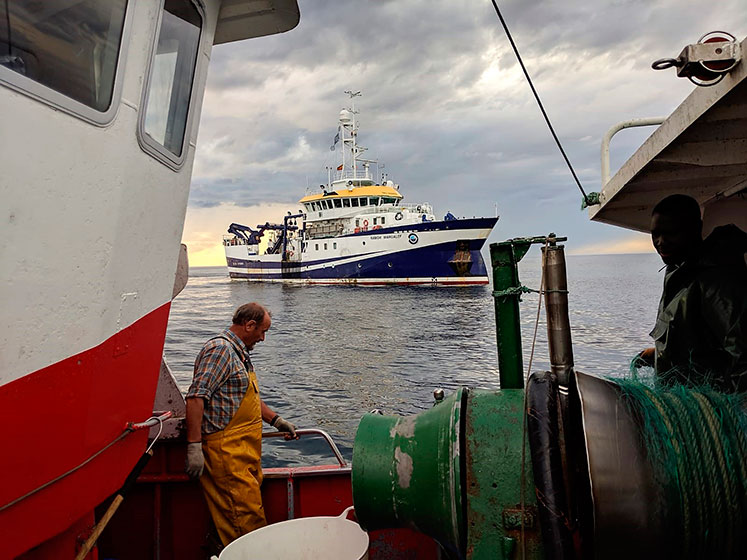


The LIFE INTEMARES project, coordinated by the Biodiversity Foundation of the Ministry for the Ecological Transition and the Demographic Challenge (MITECO), has added four new partners to advance in the expansion of marine protected areas and their effective management. Thus, the Junta de Andalucía, through the Ministry of Agriculture, Livestock, Fisheries and Sustainable Development and the Environment and Water Agency; the AZTI technology centre and the Polytechnic Universities of Valencia and Alicante.
The European project LIFE INTEMARES, coordinated by the Biodiversity Foundation of the Ministry for Ecological Transition and the Demographic Challenge (MITECO), has added four new partners to advance in the expansion of marine protected areas and their effective management. Thus, the Regional Government of Andalusia, through the Ministry of Agriculture, Livestock, Fisheries and Sustainable Development and the Environment and Water Agency; the AZTI technology centre and the Polytechnic Universities of Valencia and Alicante have joined. These entities join the team of partners that has been working in a coordinated manner since the beginning of the project in 2017 and that integrates a diverse representation of competences and interests.
The Ministry itself, which holds the competences in the management of the Natura Network in the marine environment through the General Directorate of Biodiversity, Forests and Desertification; the Spanish Institute of Oceanography (IEO), a benchmark entity in Spain in the scientific knowledge of the sea; the Spanish Fisheries Confederation (CEPESCA), the most representative national fishing business organisation in the European Union; as well as two NGOs with extensive experience in the conservation of marine biodiversity, such as SEO/BirdLife and WWF-Spain.
These four new additions strengthen research and conservation of marine biodiversity, new technologies for monitoring habitats and species, as well as governance and institutional cooperation.
Promotion of blue entrepreneurship and declaration of new protected areas
In particular, the Regional Government of Andalusia will develop actions to improve the knowledge and monitoring of marine habitats. It will also involve the various agents of the territory in the management of protected areas, undertake awareness-raising actions and ensure the implementation of mechanisms to mitigate the impact of recreational activities on habitats of community interest, mainly posidonia meadows, reefs and underwater caves. It will also promote blue entrepreneurship in Natura Network sites in the marine environment of Andalusia.
For its part, AZTI participates together with the IEO in the research campaigns that are being developed for the declaration of new protected marine areas, specifically, in the Cap Bretón submarine canyon system, which is home to species and habitats of high ecological value. It also participates in the tagging and monitoring actions of the Balearic shearwater, together with MITECO and SEO/Birdlife, to learn more about this seabird, the most endangered in Europe.
The University of Alicante also works together with the IEO, through its mixed unit, on oceanographic campaignsin Cabo Tiñoso, in Murcia, with the aim of increasing the knowledge of marine habitats and species in the area between the Escarpment of Mazarrón, Seco de Palos and the field of pockmarks, underwater structures caused by gas emissions.
Finally, the Polytechnic University of Valencia also collaborates with the IEO in the technological development of a marine observation network based on platforms that allow the study of the dynamics of the seabed, current fields, suspended matter and underwater noise, as well as in the use of unmanned underwater vehicles for the monitoring of habitats and species. They also develop electronic and acoustic tags in the monitoring of species to study the connectivity between protected areas.
Since 2017, the year in which the LIFE INTEMARES project started, more than 770 organisations have been directly involved in it, which have participated in various actions to ensure that the increase in marine protected areas is associated with the improvement of knowledge, as well as the strengthening of coordination and a governance structure from a participatory approach that integrates all managers. agents and users of the sea.
Do you want to know more about this project, with which Spain has set itself the goal of reaching a coverage of more than 15% of the marine protected area by 2023? Here you have all the information.