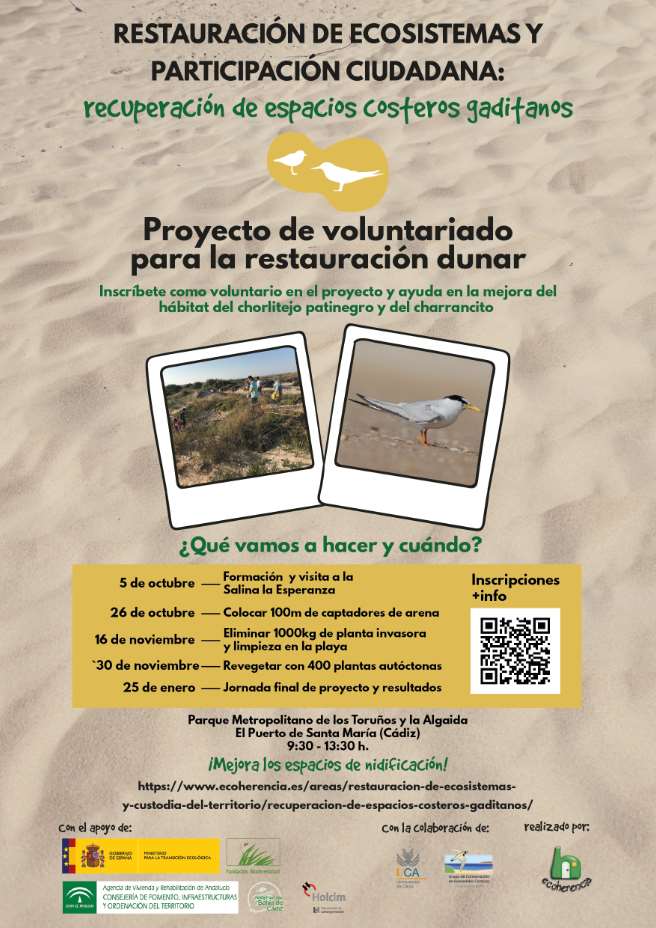
Ecosystem restoration and citizen participation: recovery of coastal areas in Cadiz
MITECO
• The project has served to improve the habitats of species of community interest on the Cadiz coast through restoration tools, citizen participation and science, volunteering and environmental awareness in areas of the Natura 2000 Network in the Bahía de Cádiz Natural Park.
• The habitats where the project has been developed are in a regressive state of conservation, vulnerable to climate change and anthropic pressure, where birds of community interest nest, classified as vulnerable.
• The restoration work has contributed to intensifying the native flora, through the planting of 475 native dune plants, the elimination of 2,100 kilograms of invasive plant species and the removal of 390 kilograms of waste from the Bahía de Cádiz Natural Park on 5 hectares.
• The participation of 366 total volunteers has been achieved in all its actions, raising awareness of the importance of the ecosystem services of the dune and marsh habitat.
• The project has served to improve the habitats of species of community interest on the Cadiz coast through restoration tools, citizen participation and science, volunteering and environmental awareness in areas of the Natura 2000 Network in the Bahía de Cádiz Natural Park.
• The habitats where the project has been developed are in a regressive state of conservation, vulnerable to climate change and anthropic pressure, where birds of community interest nest, classified as vulnerable.
• Restoration work has contributed to intensifying the native flora, through the planting of 475 native dune plants. The restoration of these areas has also been promoted, through the elimination of 2,100 kilograms of invasive plant species and the removal of 390 kilograms of waste from the Bahía de Cádiz Natural Park on 5 hectares.
• The participation of 366 total volunteers has been achieved in all its actions, raising awareness of the importance of the ecosystem services of the dune and marsh habitat.

Line of action:
Terrestrial ecosystemsStatus:
FinalizadoExecution date:
2019The project has sought to improve and restore areas of great ecosystem and landscape value in the Bahía de Cádiz Natural Park, in addition to raising awareness among the population with volunteer actions and citizen participation to raise awareness among the local population about the importance of the ecosystem services of the dune and marsh habitat. The initiative wanted to highlight the role of citizen participation, necessary as a strategy against the effects of climate change.
The habitats where the project has been developed are in a regressive state of conservation, vulnerable to climate change and anthropic pressure, where birds of community interest nest such as the Kentish plover (Charadrius alexandrinus) and the little tern (Sternula albifrons), included in the Red Book of the birds of Spain in the category of “Vulnerable”. The restoration work has been intended to help intensify native flora species and eliminate invasive species.
The general objective of the project is to improve the habitats of species of community interest on the Cadiz coast through restoration tools, citizen participation and science, volunteering and environmental awareness in areas of the Natura 2000 Network in the Bahía de Cádiz Natural Park.
The specific objectives are:
- To contribute to the restoration, improvement and maintenance of the natural ecosystem of the areas of action.
- To protect and improve the habitat of the Kentish plover (Charadrius alexandrinus) and the little tern (Sternula albifrons), species classified as vulnerable.
- To raise awareness among the population about the environmental situation of the Cadiz coast and the need to improve the habitat of species of community interest, highlighting the importance of the Natura 2000 Network in the areas of action.
- To promote citizen involvement with participatory methodologies and citizen science for the development and monitoring of actions.
- Carrying out several days, also framed in the volunteer program, for the execution of restoration and improvement work of the coastal ecosystem of Cadiz with citizen participation.
- Design of didactic and informative material. Within the framework of the project, an informative Field Manual has been produced that informs about the ecosystems of the park and their importance.
- Presentation and dissemination day of a volunteer program with citizen participation for the improvement and restoration of the Cadiz coast. These conferences also served to measure the degree of knowledge of the population about the ecology of the area and its associated problems.
- Training day, framed in the volunteer program, for the improvement and restoration of the Bahía de Cádiz Natural Park.
- Awareness days and workshops for young people in the area, students of Compulsory Secondary Education and Vocational Training.
- Project completion day. Dissemination and dissemination of the results.
The project has served to improve the habitats of species of community interest on the Cadiz coast through restoration tools, citizen science and participation, volunteering and environmental awareness in areas of the Natura 2000 Network in the Bahía de Cádiz Natural Park. The initiative has had the participation of 366 total volunteers in all its actions, through which they have managed:
- Recovery of coastal spaces, through the placement of 100 linear metres of wicker rods, called sand collectors, forming a sand retention system that favours the creation of dunes. The elimination of 2,100 kilograms of the invasive plant Carpobrotus edulis, the removal of 390 kilograms of waste from the Natural Park in 5 hectares and the planting of 475 native dune plants were also carried out.
- Improvement and promotion of the nesting of the little tern and the Kentish plover: on the one hand, 8m3 of gravel was spread through the crystallizers (place where the crystallization of salt occurs in a salt flat) of the La Esperanza salt mine and another 8m3 of subbase to achieve the yellow color. With the contribution of this type of substrate, there is a layer of stones and loose material between the clay of the salt mine and the eggs of the birds that prevent them from sticking to the clay with the water. The fact that the last layer has an albarizo (yellowish) colour is due, according to the project, to the fact that it has been found that these species prefer this type of colour over others. On the other hand, 8 periquillos (wooden gates that serve to control the flow of water) were made in the La Esperanza salt flat.
- Creation of a group of more than 30 volunteers.
- Participation of 106 schoolchildren in the salt mine awareness days.
- Preparation and printing of 250 copies of a Field Manual produced within the framework of the project. This document is a tool with which to recognize the ecosystems of the Cadiz coast of the Bay of Cadiz, identify the species that inhabit it, learn about some of the restoration techniques and train the population in citizen science work.
- Preparation and placement of 2 information panels on Levante Beach, in the Bahía de Cádiz Natural Park, to inform and raise awareness among the population about the species of the habitat and the vulnerability of the little tern and the Kentish plover; as well as the importance of the dune system and good practices as users of the Natural Park.
Ecosystem restoration and citizen participation: recovery of coastal areas in Cadiz

 back to search